
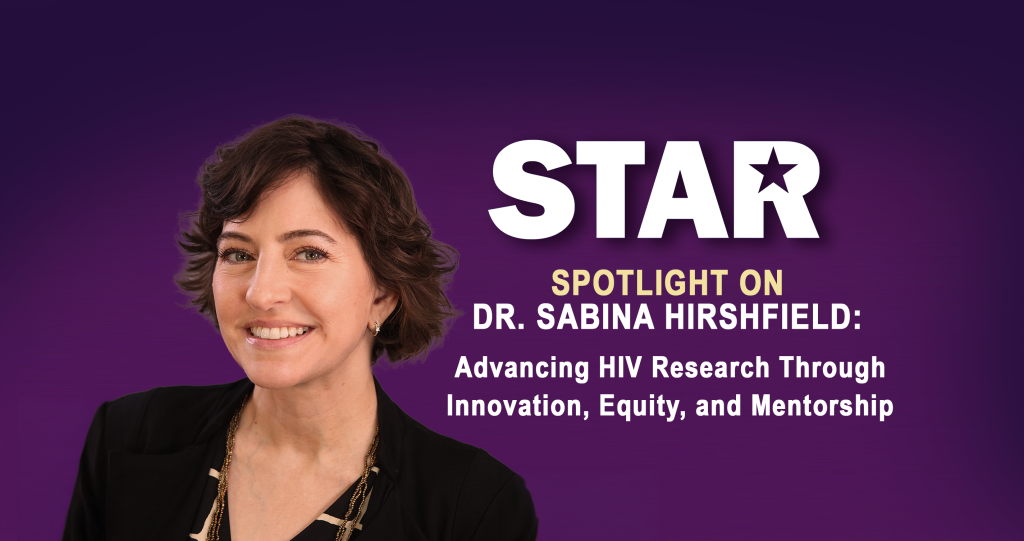
Dr. Sabina Hirshfield is a public health scientist whose research addresses the intersections of HIV prevention, care engagement, and health disparities in digital spaces. Over more than two decades, her work has evolved alongside major changes in the HIV landscape – from early online studies of sexual health risk, to digital and mobile health interventions, to self-sampling and point-of-care strategies designed to expand access to prevention and care for communities disproportionately affected by HIV.
Trained in sociology, epidemiology, and public health, Dr. Hirshfield earned her BA from SUNY Binghamton, her MA from St. John’s University, and her PhD from Columbia University. Before joining SUNY Downstate in 2018, she spent 17 years at Public Health Solutions in New York City, where she helped pioneer internet-based HIV research with sexual minority populations. At the STAR Program at Downstate, she has continued to build an interdisciplinary research program rooted in health equity, technology, and translational impact.
A defining feature of Dr. Hirshfield’s scholarship is its scope and adaptability. Her early work helped establish the internet as a viable platform for behavioral HIV research, including online recruitment and surveys on sexual risk, substance use, and HIV testing. Over time, her research expanded into eHealth and mHealth interventions, including tailored digital messaging and video-based approaches. More recently, she has focused on biomedical prevention and monitoring strategies, including home-collected dried blood spot specimens for viral load monitoring, point-of-care testing, and interventions addressing stimulant use, antiretroviral therapy adherence, and improved quality of life among people living with HIV.
Since 2000, Dr. Hirshfield has led or collaborated on 36 federal grants, representing more than $50 million in support from NIH, CDC, and HRSA. Her roles have included Principal or Multiple Principal Investigator, Co-Investigator, Evaluator, and Consultant.
Her research projects reflect a translational focus in response to evolving public health needs. Current and recent NIH-funded work includes: reducing stigma and increasing HIV testing and care among men who have sex with men (MSM) in the Georgian Republic; developing a point-of-care triple test for HIV, Hepatitis B, and Hepatitis C in non-clinical settings; improving HIV outcomes and quality of life among rural older adults in the U.S.; and supporting a family-based HIV prevention and care intervention for Black sexual and gender minorities in House Ball communities in NYC, Atlanta, and Dallas. Pending research will test the feasibility and acceptability of remote urine drug-checking and cardiac injury testing and report-back of results among MSM with HIV who report stimulant use.
Dr. Hirshfield has authored 122 peer-reviewed publications, including more than 70 since joining Downstate, with major contributions as senior author, first author, and mentor-author. Across this body of work, she has helped define how digital tools, self-sampling methods, and community-informed interventions can expand access to HIV prevention and care. https://scholar.google.com/citations?user=fy3K49sAAAAJ&hl=en
Mentorship is equally central to her work at Downstate. Her faculty role is divided between research and mentorship. She mentors medical students, graduate and doctoral students, postdoctoral fellows, and junior faculty in team science, manuscript development, grant writing, and ethical research conduct. She describes mentorship as a two-way relationship grounded in collaboration, skill development, elevation, and advocacy. She has published with many mentees – most as first authors, and has helped mentees secure NIH diversity supplements, fellowships, and independent funding. Her broader vision is to build more structured mentorship opportunities for junior and underrepresented scholars across Downstate and SUNY.
Her leadership and public impact were recently recognized through her selection as a Fellow in the SUNY Research Leadership Academy. She was also invited to present at the SUNY Research Expo at the New York State Legislature in Albany to make SUNY research more accessible to legislators, policymakers, and the public. There, she shared her work on home-based testing for early cardiac injury using portable troponin technology. The video and a copy of the presentation are available here: SUNY Expo Deck.pdf
More recently, Dr. Hirshfield accepted a new leadership role as co-chair of the College of Medicine’s working group on Encouraging Engagement in Research and Scholarship, part of the development of the College’s new five-year Strategic Plan. In this role, she will help guide faculty and staff in identifying priorities, goals, and strategies to strengthen research and scholarly engagement across the College.
Looking ahead, Dr. Hirshfield’s work continues to move toward a future in which HIV prevention and care are more accessible, more responsive to people’s lives, and equitable. Whether through digital interventions, home-based biomarker monitoring, point-of-care technologies, or stronger mentorship structures, her research is guided by a central question: how can innovation better meet people where they are, and improve health outcomes in the process?